Print Queues
Print queues are installed on user workstations and represent the connection between the user's computer and a printer. A printer in HP Insights can have one or more associated queues — for example, one IPP queue and one manufacturer driver queue for the same device.
Note: Print queues configured in the web console are called Printers in the HP Secure Print desktop app
How to Create Print Queues
There are two ways to create print queues in Direct Print. Choose the method that suits your deployment size:
-
Queue Profiles (recommended for large deployments) — define rules that automatically match printers to the right queue configuration based on make, model, IP range, or location, then create queues across the entire fleet in bulk. This is the fastest approach when setting up Direct Print for the first time or on-boarding a large number of printers. See Queue Profiles.
-
Create queue manually per printer — configure a queue directly on an individual printer using the Direct > Direct Printers tab. Suitable for adding a single queue to an existing deployment or for printers with non-standard requirements. See Creating Print Queues below.
Note: Queue Profiles and manual queue creation are complementary. You can use Queue Profiles to bulk-create queues across a fleet and then manually adjust individual queues where needed.
Creating Print Queues Manually
1. Navigate to Direct → Direct Printers.
2. Select the location where the printer is assigned.
3. Select the printer for which you want to create a queue.
4. Click Create Queue. The queue properties panel opens on the right side of the screen.
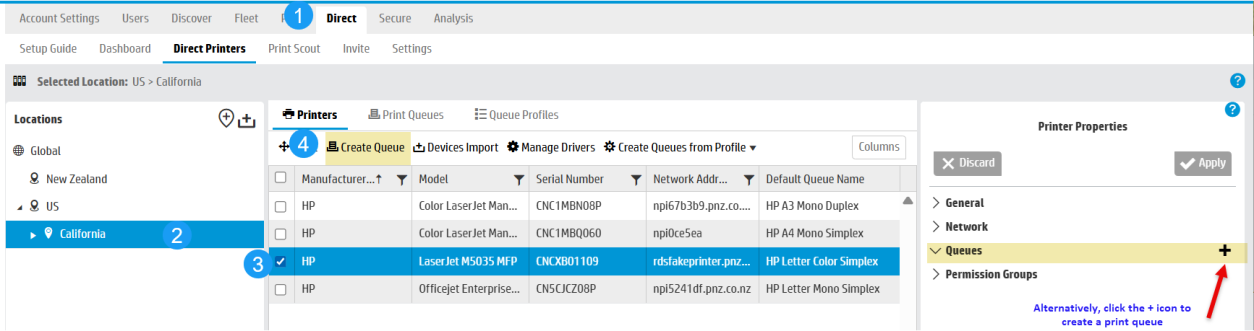
5. Configure the queue properties and click Save.
-
If the printer has IPP capability (IPP Support is set to true), the queue Type defaults to (Undefined variable: General.IPP Queue).
-
If the printer does not have IPP capability, the Type defaults to Manufacturer's Driver for Windows.
-
The queue Status is set to Disabled by default. Set it to Auto-install or Manual-install for the queue to be available to users.
Queue Properties Reference
General
| Property | Description | ||||||||||||||||||||
|---|---|---|---|---|---|---|---|---|---|---|---|---|---|---|---|---|---|---|---|---|---|
| Name |
The name users see when selecting a printer on their workstation and in the HP Secure Print desktop app. By default, the name is built from the Printer Label if available, otherwise from the Manufacturer and Model. Use a naming convention that helps users identify finishing options — for example, HP LaserJet M5035 — Duplex Mono or HP LaserJet M5035 — Simplex Colour. |
||||||||||||||||||||
| Type |
The driver type used to deliver the print job. Options: Manufacturer's Driver for Windows — the queue connects directly to the printer via a standard TCP/IP port. Requires an OEM driver to be installed on the workstation. HP IPP Class Driver — the HP driver sends the job to the Print Scout service, which delivers it immediately to the printer. No OEM driver installation is required. The driver installed on the workstation depends on the Windows version:
Note: In mixed Windows ARM and Intel environments, Intel workstations may show both manufacturer and IPP queues. HP recommends using IPP queues for both ARM and Intel platforms to ensure consistent behaviour. |
||||||||||||||||||||
| Status |
Controls whether and how the queue is deployed to workstations: Disabled (default) — the queue is not visible or installed. If an existing auto-install queue is set to Disabled, it is uninstalled on the next service restart or overnight reset. Manual-install queues are not automatically uninstalled. Manual-install — users install the queue themselves from the HP Secure Print desktop app. Auto-install — Print Scout installs the queue automatically on workstations that match the location's network information. Requires network information (IP range, gateway, or Wi-Fi SSID) to be configured on the location. |
Configuration
| Property | Description |
|---|---|
| Driver |
The OEM print driver for the queue. Available for Manufacturer's Driver queues only. Select the driver that matches the printer's PDL — for example, HP Universal PCL 6 for HP devices. If the required driver is not in the list, upload it using the Driver Capture Tool. |
| Delivery Service |
Available for Manufacturer's Driver queues only. Controls how the print job is delivered to the printer: HP Secure Print Service (default, recommended) — the job is delivered via the Print Scout service using encrypted communications. Windows Print Spooler — the job is delivered via a standard Windows TCP/IP port using RAW over port 9100. HP recommends using the HP Secure Print Service to maintain encrypted job delivery. |
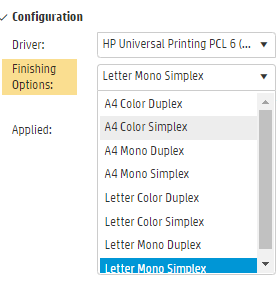
| Finishing Options |
The default print settings applied when the queue is installed. Windows queue — select finishing options from the available list.
IPP queue — click Edit to configure paper size, colour, and duplex. If no finishing options are set for an IPP queue, the defaults are Letter, Colour, and Simplex. |
| Applied |
Available for Auto-install queues only. Controls how often user preference changes are reset to the configured defaults: New Install Only — finishing options are applied at install time. Admin changes to printing preferences are preserved. If an administrator updates the queue settings (driver, finishing options, queue name), those changes are still applied as a one-off overnight update. Every Day — finishing options reset to the configured defaults overnight. For example, if a user changes from Mono to Colour, the queue reverts to Mono the next day. Every 15 / 30 / 45 minutes, 1 hour, etc. — finishing options reset at the specified interval. For example, with a 15-minute interval, if a user switches to Color at 9:00 AM, the queue reverts to Mono by 9:15 AM. |
Advanced
| Property | Description |
|---|---|
| IPP URL | Read-only. The IPP URL of the printer associated with this queue. Uses the printer's configured IPP URL if available, otherwise uses the Discovered IPP URL. |
Related Topics: