Guest Print
Guest Print allows visitors, contractors, and other non-employees to print without requiring an account in your organization.
How Guest Print works
Guest Print enables guests to submit documents for printing and securely release them at a printer using a temporary passcode.
The process begins when an employee sends an invitation to a guest. The invitation contains a link to the Secure Print Guest Portal, where the guest can upload documents from a web browser. After submitting a print job, the guest receives an email containing a system-generated passcode. To print the documents, the guest enters the passcode at a supported printer where Guest Print is enabled.
Guest access is controlled through the invitation link. By default, invitations expire 30 days after they are sent, although administrators can configure the expiration period between 1 and 730 days.
Supported file formats
| Format | Maximum file size |
|---|---|
| 250 MB | |
| Microsoft Office (.doc, .docx, .xls, .xlsx, .ppt, .pptx) | 60 MB |
| JPEG, BMP, PNG | 50 MB |
| TXT | 10 MB |
Guest Print workflow
An employee enables Guest Print
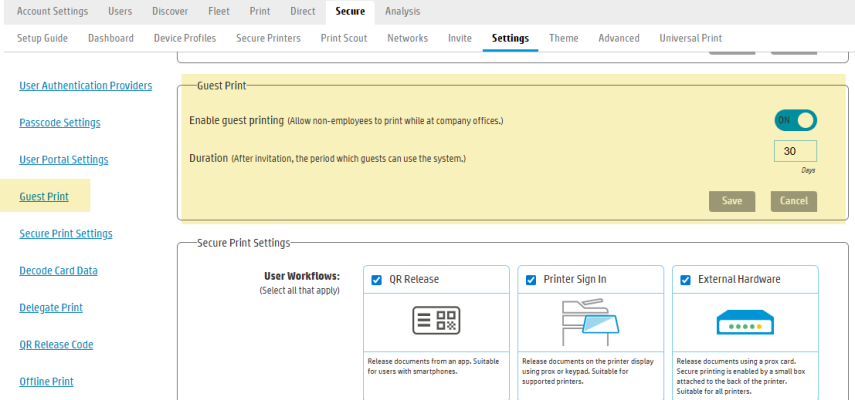
- An employee (with suitable permission) enables Guest Print by toggling the Enable guest printing setting in the Secure > Settings screen.
An employee invites a guest user
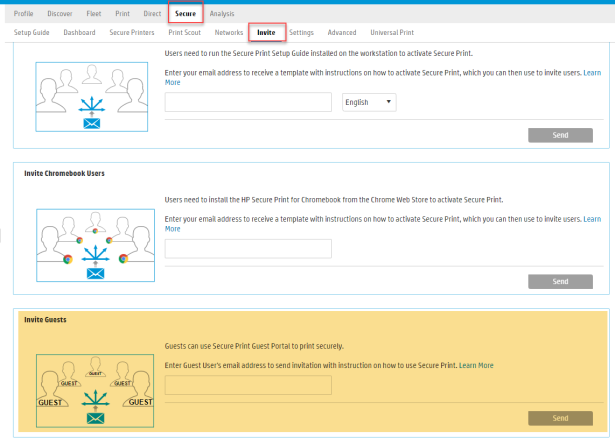
- The employee navigates to the Secure > Invite tab of the web portal.
- In the Invite Guests section, the employee enters the guest user’s email address to send an invitation with instructions on how to use Secure Print.
- The employee clicks Send.
The guest user opens the invitation email and uploads documents to print
- The guest user receives a Guest Print invitation email. This invite includes a link to the Secure Print Guest Portal. It also includes instructions on how to use the Guest Print system.
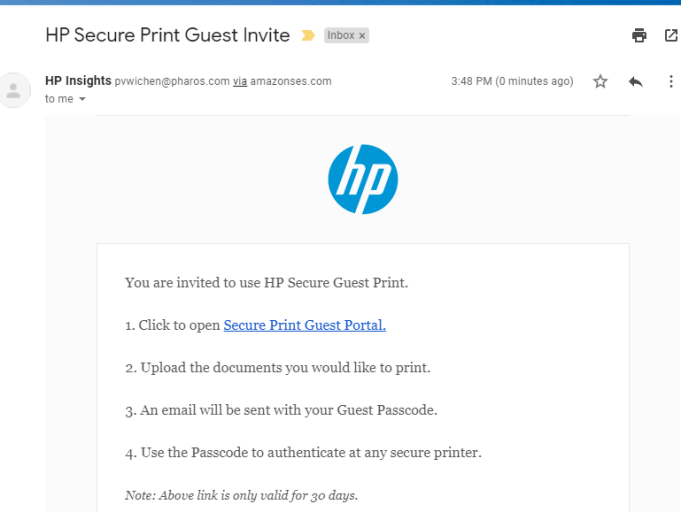
- The guest opens the Secure Print Guest Portal by clicking the link in the email.
- The guest uploads documents to print.
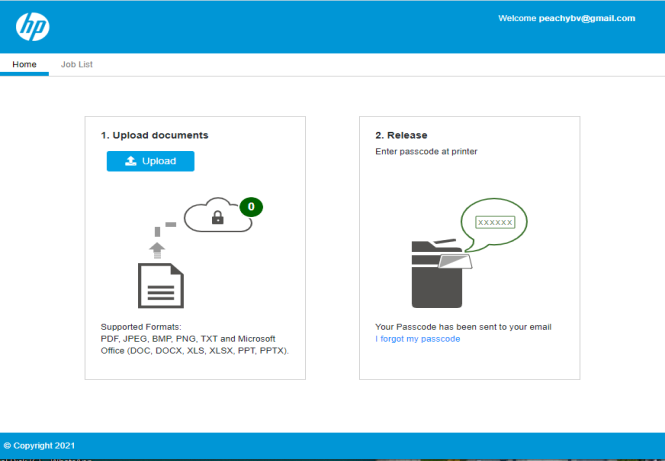
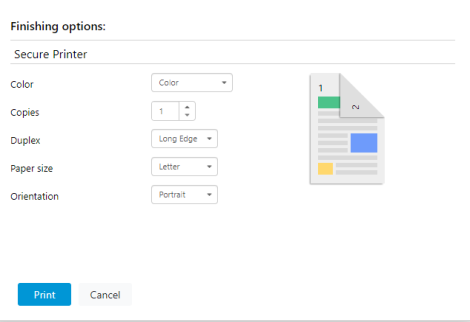
- The guest user clicks Print. Documents are transferred and stored securely in the cloud.
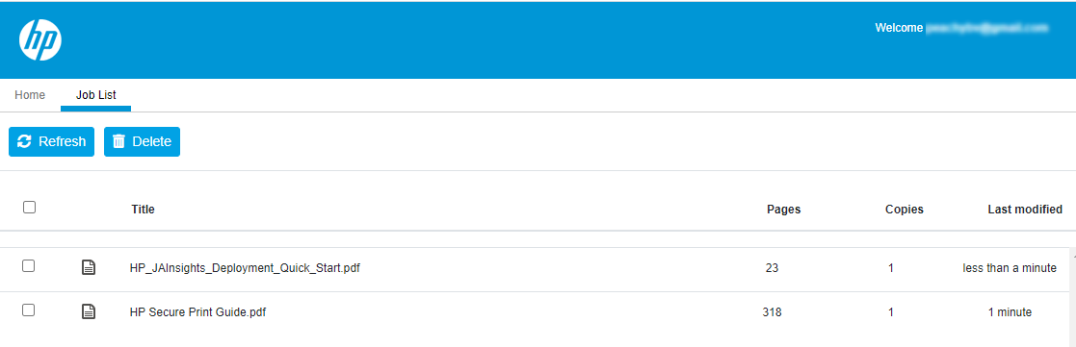
- Optional: The guest user clicks the Job List tab to view a list of uploaded print jobs. Users can also delete jobs from this view.
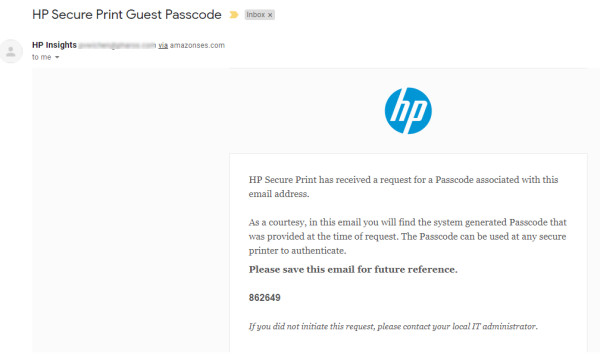
- Once the print job is submitted, the guest receives another email containing the system-generated passcode. This passcode is used to authenticate at a supported printer to release documents.
The guest user releases documents
- The guest goes to a supported printer where Guest Print is enabled.
- The guest authenticates at the printer using the passcode they received by email.
- The guest releases the documents.
Why guests authenticate with a passcode
Employees authenticate at a printer using their identity: a card, the mobile app, or their credentials. A guest has no identity in your system, so Guest Print issues a passcode instead. The passcode is tied to the person who uploaded the documents, which means a job can only be released by whoever submitted it, and nothing is left sitting in an output tray.
The passcode is generated once the guest submits a print job, and is sent to the email address the invitation was sent to. If they lose it, the I forgot my passcode link in the Guest Portal issues a new one to the same address.
Because it relies on passcode authentication, Guest Print works only on printers that support it. Passcode authentication is currently documented for HP, Konica Minolta, Canon and Lexmark printers. See Passcode Authentication.
What Guest Print requires
- OpenID Connect or SAML authentication. Internal and Active Directory authentication are not supported, because the employee issuing the invitation is redirected to the authentication provider to sign in.
- Passcode Only Release enabled, since that is how guests authenticate at the device.
- A printer that supports passcode authentication. This is currently available on HP, Konica Minolta, Canon and Lexmark printers.
- System user permission for the employee sending invitations.
Where guests can print
Guest Print availability is controlled at two levels:
- Organization level: Enables or disables Guest Print across the organization.
- Device Profile level: Determines which printers can accept guest print jobs.
Guests can print only when Guest Print is enabled at both levels. The organization setting makes Guest Print available, while Device Profile settings determine the printers where guests can use the feature.
This allows organizations to offer Guest Print on selected printers while keeping it unavailable on printers used for employee-only or sensitive printing. For example, Guest Print might be enabled on printers in reception areas, lobbies, or visitor centers, while remaining disabled on printers used by departments that handle confidential information.
Example
| Device Profile | Guest Print |
|---|---|
| Lobby Profile | Enabled |
| Secure Finance Profile | Disabled |
| Default Profile | Applied to all other printers unless another profile is assigned |
If a guest attempts to sign in at a printer where Guest Print is not enabled, the printer displays a message indicating that guest printing is unavailable on that device.
Limitations
- Paper size and orientation cannot be changed for uploaded PDF and Microsoft Office documents.
- Uploading from a mobile device supports PDF and Microsoft Office formats only. Images and text files are not supported.
- The invitation link expires after the configured Duration. The default is 30 days, and the range is 1 to 730 days.
- Guests can only release jobs at supported printers where Guest Print is enabled in the assigned Device Profile.